Espresso at Home: Pressure, Grind and Milk
Twenty bar on the box, nine bar at the coffee, and a grinder that decides more than either. What the numbers on an espresso machine mean, and how to use them to fix a bad shot.

- What 15 or 20 bar actually means
- Pre-infusion: the quiet second at the start
- The grinder decides more than the machine does
- Dialling in, in one variable at a time
- Reading a bad shot
- Water: temperature, and the descaling nobody schedules
- Milk: texture is the skill, not the machine
- How much of this you should actually drink
- Cleaning, in the order things actually get dirty
- Where to start, if you are starting
Espresso is a small, strange way to make coffee. Instead of letting water sit with grounds for four minutes, it forces hot water through a tightly packed puck in about twenty five seconds, and the resistance of that puck is the whole point. Get the resistance right and you get a thick, sweet, syrupy shot with a layer of crema on top. Get it wrong in either direction and you get something sour and thin, or something bitter and burnt, from exactly the same coffee and exactly the same machine.
Everything below is about controlling that resistance. It is worth saying at the start that this is learnable in a week, not a year, and that the two things that shorten the learning curve most are a burr grinder and a machine that shows you what it is doing.
What 15 or 20 bar actually means
A bar is roughly the pressure of the atmosphere at sea level. Espresso, as an extraction method, is defined around nine bar at the coffee: that is the figure commercial machines are calibrated to and the figure the drink was designed around. So why does every home machine, ours included, advertise fifteen or twenty?
Because the number on the box describes the pump, not the puck. A vibratory pump is rated at the maximum pressure it can generate with the outlet closed, and the pressure that reaches the coffee is always lower, because the system bleeds off the excess and because the puck itself is what creates the working resistance. A twenty bar pump is a pump with enough headroom to sustain nine bar at the basket through a whole shot without sagging as the puck softens. It is a specification about reserve, not about what hits the coffee.
This is also why an over pressure valve matters more than a bigger number. Ours opens automatically when the system goes above target and vents the excess rather than forcing it through the coffee, which is what stops a fine grind from turning into a bitter, channelled mess. On the machines with a gauge on the front, you can watch this happen.
| The number | What it actually measures | What it means for your shot |
|---|---|---|
| 15 or 20 bar | Maximum pump pressure, outlet closed | Headroom. The coffee still sees roughly 9 bar |
| 9 bar | Working pressure at the puck | The target. This is the figure a front gauge shows during extraction |
| 198 F | Brew water temperature | Too cool tastes sour, too hot tastes burnt |
| 25 to 30 s | Shot time from pump start | The main dial-in feedback. Too fast means the grind is too coarse |
| 1:2 ratio | Dose in, liquid out, by weight | 18 g of coffee giving about 36 g of espresso is the usual starting point |
| 51 or 58 mm | Portafilter basket diameter | 58 mm is the commercial size; baskets and tampers are not interchangeable between the two |
Pre-infusion: the quiet second at the start
If you watch a good shot begin, nothing much happens for a moment. That is pre-infusion, and every machine in our range does it. Before the pump goes to working pressure, water wets the puck at low pressure and the grounds swell and seal against the walls of the basket.
Without that step, full pressure arrives at a dry, unevenly packed bed and does what water always does: it finds the path of least resistance and drills through it. That is channelling, and it is why a shot can run pale and fast on one side of the basket while the rest of the puck stays barely touched. The taste of a channelled shot is sour and thin, and no amount of pressure fixes it, because pressure is what caused it.
The grinder decides more than the machine does
This is the least popular advice in home coffee, because it means the machine was not the whole purchase. But it is true, and it is easy to demonstrate: the same machine, same beans and same dose will produce a completely different drink at two grind settings a few clicks apart.
A blade grinder chops. Run it long enough for the coarse pieces to break down and you have already reduced part of the batch to dust. Both sizes then sit in the same basket, and water extracts them at completely different rates: the dust gives up everything and turns bitter, the boulders barely give up anything and taste sour. The cup tastes like both at once, which is the flat, muddled flavour people blame on cheap beans.
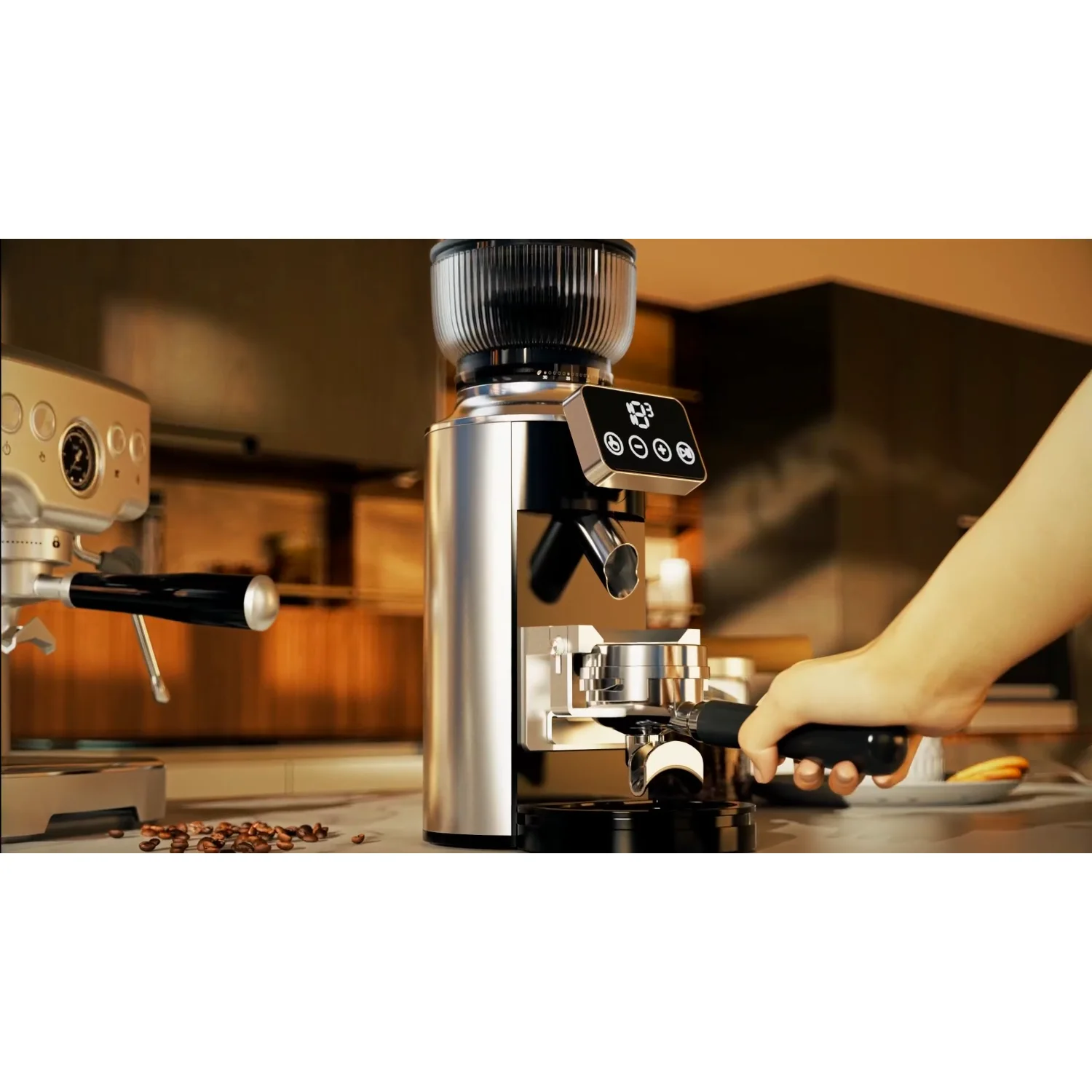
Burrs work differently. Two shaped surfaces sit a set distance apart and beans pass between them, so particles come out at a size determined by that gap rather than by how long the motor ran. Conical burrs, the geometry we use, keep the proportion of fines low, and the result is a bed that resists water evenly. That evenness is the thing a 20 bar pump needs in order to behave the way its number promises.
Thirty click settings sound like more than anyone needs, until the first bag of a different roast arrives and the setting that worked last week runs three seconds fast. Beans change with roast level, freshness and even humidity, so a grinder without fine steps means permanently living with shots that are nearly right.
Dialling in, in one variable at a time
Dialling in is the process of finding the grind setting at which a given coffee, at a given dose, gives you the yield you want in the time you want. It is boring, it takes about four shots, and it is the difference between a machine that makes coffee and a machine that makes espresso.
Fix everything except the grind. Weigh the dose the same every time, tamp with the same firmness, and use a scale under the cup. Then change only the grind, one or two clicks at a time, and read the clock.
- Start at 18 g of coffee in a double basket, aiming for about 36 g of liquid espresso.
- Pull a shot and time it from the moment the pump starts.
- If it finished in under 20 seconds, the grind is too coarse. Go finer by two clicks.
- If it took more than 35 seconds or barely dripped, the grind is too fine. Go coarser by two clicks.
- When the shot lands around 25 to 30 seconds, taste it. Sour means under extracted: finer, or a touch hotter. Bitter and dry means over extracted: coarser.
- Write the setting down with the name of the bean. You will need it again in three weeks.
Reading a bad shot
| What you saw or tasted | Usual cause | Fix |
|---|---|---|
| Ran in 10 to 15 seconds, pale, thin | Grind too coarse, or dose too light | Two clicks finer, and check the basket is properly full |
| Barely dripped, dark, bitter | Grind too fine, or tamped far too hard | Two clicks coarser; tamp firm and level, not with body weight |
| One side of the basket pours faster | Channelling, from uneven distribution | Level the grounds in the basket before tamping; tamp square |
| Sour, even at a good time | Under extracted, or water too cool | Slightly finer; let the machine come fully up to temperature first |
| Bitter and drying, at a good time | Over extracted, or stale dark roast | Slightly coarser; try a fresher or lighter bean |
| No crema at all | Stale beans, most often | Beans more than a month past roast rarely produce crema whatever you do |
| Gushes with no resistance | Pressurised basket used with a dose meant for a standard one | Match the basket to the dose, or fill the basket properly |
Water: temperature, and the descaling nobody schedules
Espresso is about ninety eight percent water, so the water is not a detail. Two things about it matter in practice. The first is temperature: our machines target 198 F, which sits in the range espresso is conventionally brewed at, and the reason a machine wants a warm up period is that a cold group head pulls the temperature of the first shot below target. Two minutes of warm up, and a blank shot through the empty portafilter, cost nothing and fix the first coffee of the day.
The second is scale. Every heating element in every machine that boils water accumulates mineral deposits, and the harder your water, the faster. Scale insulates the element, which drops the brew temperature, and eventually blocks the flow path. It is the single most common cause of a machine that has slowly got worse without ever breaking. Descale on the schedule in the manual, and more often if your kettle furs up quickly; use filtered water if it does.
Milk: texture is the skill, not the machine
A steam wand injects steam into milk and does two jobs at once: it heats it, and it folds air into it. Doing both well at the same time is the entire craft, and most people learn it in about twenty attempts.
The short version: start with cold milk in a cold pitcher, filled between a third and a half. Put the tip of the wand just under the surface, off centre, so the milk spins. Hold it there for the first few seconds and you will hear a soft tearing sound, which is air going in. Then sink the tip deeper and let the whirlpool do the rest, which folds those bubbles down into the body of the milk until it looks like wet paint rather than foam. Stop at about 140 to 150 F, when the pitcher becomes uncomfortable to hold. Past 160 F the proteins start to break down and the sweetness goes.
The pitcher itself matters more than it should. A narrow spout gives you a controllable pour; a wide one gives you a splash. Twelve ounces is right for one or two drinks, twenty ounces for two large ones. And purge the wand before and after every use: a second of steam clears condensate before, and a wipe plus a purge after stops milk drying inside the tip, which is the usual reason a wand loses power.
How much of this you should actually drink
Cleaning, in the order things actually get dirty
Coffee oils go rancid, and rancid oil is the taste people mistake for a machine getting old. Three routines cover almost everything. After every session, knock the puck out, rinse the basket and portafilter, and purge and wipe the steam wand. Weekly, take the basket out and scrub both it and the portafilter properly, because the underside of the basket rim collects a ring of oil that a rinse never touches. Monthly, or on the manual's schedule, descale.
A second portafilter is a small luxury that removes a real friction: you can pull one shot while the other is still full, which matters when you are making two drinks for two people who would like them at the same time. Ours come in 51 mm and 58 mm, and the two are not interchangeable, so match the size to the machine body.
Where to start, if you are starting
If you want espresso tomorrow and have not bought anything yet, the honest order of priority is: machine with pre-infusion, then a burr grinder, then a scale, then a decent pitcher. That is also the order in which they get expensive, which is why the machine and grinder sets exist: buying the two together is usually less than buying them separately three weeks apart.
If you already have a machine and something is not right, the odds are heavily on the grinder or the beans rather than the pump. Fresh coffee and even grounds fix more shots than a bigger number on a box ever has.
The full range sits on the Neretva espresso machines shelf, with portafilters, pitchers and wands on espresso accessories. If your counter has a bread machine on the other end of it, the companion guides are How to Get a Better Loaf From a Bread Machine and Bread Machine, Stand Mixer or Countertop Oven?.